


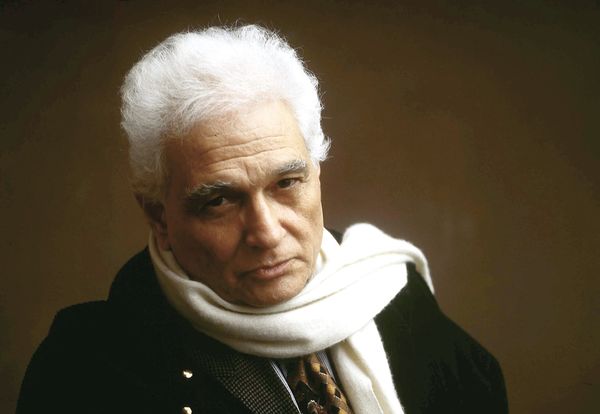
The Frenchmen: or, My Life in Theory
By Emily Eakin
Penguin Press, 471 pages, $35
Jean-Luc Godard called the French generation of the 1960s “the children of Marx and Coca Cola”; for my part, I am in some sense a child of French Theory. When I was a babbling baby, my graduate student mother wrote a poem chronicling my first efforts at speech laced with allusions to the ideas of Jacques Lacan; around that time, my father was finishing up a dissertation on the poetry of John Milton, under the heavy influence of Jacques Derrida. My parents’ infatuation with these thinkers wasn’t unusual: Their ideas were in the air people breathed in humanities academia at the time. Before I was conscious, I was inhaling it second-hand.
The result is that my relation to French Theory—that cluster of imported ideas associated with figures like Lacan, Derrida, and Michel Foucault—isn’t entirely unlike, or separable from, my relation to my family. In both cases, periods of estrangement and rebellion have alternated with periods of renewed appreciation; I find their idiosyncrasies endearing and exasperating in roughly equal measure, and the only thing more irritating to me than their all-too-familiar foibles is an ill-informed attack from an outsider. When it comes to theory, there have been plenty of those.
I therefore felt a kinship with Emily Eakin as I read her new book The Frenchmen: or, My Life in Theory. An entertaining hybrid of autobiography and intellectual history, it is outstanding not just for its lucid expositions of challenging ideas but for conveying viscerally what the encounter with them felt like in the early years of their stateside reception. “Theory was a symbol,” as Eakin recalls, “of intellectual nonconformism, a badge, like a pink mohawk, that marked you as a member of the counterculture, different from—and critical of—the docile horde.”
Although she experienced theory as a mode of rebellion, she had also, like me, first been initiated into it by her academic family. On this front, Eakin’s theory pedigree is more impressive than mine. She spent part of her childhood at its Ground Zero—Paris—while her parents were on sabbatical there; she recounts her mother picking her up late from preschool after attending a lecture by Claude Lévi-Strauss. Eakin then attended Harvard at the peak of theory’s 1980s vogue, and studied with some of its leading American acolytes.
By the time I arrived at graduate school in the mid-aughts, theory was still very much in the air, but its novelty had worn off; it had become, in a phrase Eakin quotes from the literary scholar Nicholas Dames, “part of the furniture of our lives.” By then, mainstream culture, which had once found the theorists titillating enough to dedicate cover articles and magazine spreads to their antics, had wearied of them. Not long before I enrolled in doctoral studies, Eakin was working on the ideas beat at The New York Times when the paper published an infamous contemptuous obituary of Derrida, the headline of which dismissed the philosopher as an “abstruse theorist.” In her penultimate chapter, she confesses that she was consulted by the obit’s editor before publication and—to her apparent regret—signed off on it.
Around the same time, Eakin also reported for the Times on a symposium on “the future of theory” convened by the leading journal Critical Inquiry. The illustrious participants, she discovered, sounded “despondent about the value of their work.” The headline for her write-up of the event captured the desultory mood: “The Latest Theory Is that Theory Doesn’t Matter.” The same year, the British Marxist Terry Eagleton, whose primer Literary Theory has initiated generations of students, published a book called After Theory, a sort of obituary for French Theory writ large. What exactly was supposed to come next was anyone’s guess. During my grad school years, that situation provoked no end of anxiety for aspiring scholars hoping to place the right bet on the next big paradigm and reap the requisite grants and ever-scarcer tenure-track jobs.
But Eakin wants to argue that reports of theory’s death—including the one she penned back in 2003—were greatly exaggerated. The Critical Inquiry panelists, she says near the end of The Frenchmen, “were wrong” to dismiss theory’s relevance; today, she imagines, “most of them would agree.” One area of renewed pertinence, she notes, is the rise of Large Language Models, which seem to operationalize a key French Theory idea: that language is an autonomous system that can function without a human subject. In 1967, Roland Barthes proclaimed “The Death of the Author,” declaring that “to write” is “to reach that point where only language acts, ‘performs,’ and not ‘me.’” As Eakin notes, Barthes “anticipated the production of texts without authors.” Once counterintuitive, such provocations are now anything but.
“Once counterintuitive, such provocations are now anything but.”
This uncanny technological ratification of theory—as well as various other ways that what was once intellectual scandal has become what some French theorists called doxa—raises as many questions as it resolves. Theory’s allure, as Eakin reveals with self-satirizing flair in her autobiographical passages, was its oppositional, countercultural energy. So what becomes of it when something resembling its agenda is being executed by the most highly valued companies in the world; or, to name another example, when ideas drawn from queer theory, derived from Foucault’s critiques of “normalization,” are embraced by medical experts, state officials, and corporations? If theory’s core value, as Eakin tells us in the closing lines of the book, is “vigilant questioning,” what should be its inheritors’ stance toward its current institutionalized forms?
Despite her book’s other virtues, Eakin’s answer left me unsatisfied. To the extent that she celebrates theory’s conquest of common sense, she arguably betrays the legacy of skepticism she otherwise endorses. Notably, in the final chapter, she hails theory’s “imprint on the revolution in gender pronouns,” declaring: “The more fluid our language, the more capacious and less confined our self-definitions, our bodies, our imaginations—and, eventually, the more tolerant our social order.” But any serious reader of Foucault, who contended that what might look like the freeing up of sexuality turns out to be its ensnarement in new discursive regimes, should surely be wary of the ostensible liberation being heralded here. We needn’t go into the intricacies of Foucault’s thought to wonder whether demands that we attach pronouns to our public identities and identify our internally felt “gender identities” are in fact ways of achieving a “less confined self-definition”—or the opposite. Such matters, in any case, merit “vigilant questioning,” but Eakin applauds the fact that the answers are now “intuitive to Generation Z.”
One Frenchman whose name never appears in Eakin’s book is René Girard, and not for lack of opportunity to mention it. Girard was the lead organizer of the 1966 Johns Hopkins symposium “The Languages of Criticisms and the Sciences of Man,” the watershed event that introduced French Theory to American academia and the subject of a chapter in The Frenchmen. Eakin even refers to the “enterprising trio of professors” who organized the event, and goes on to name two of them, Richard Macksey and Eugenio Donato, but not the most famous of the three. One of the sources cited in the notes for the chapter on the Hopkins symposium is Cynthia Haven’s 2018 biography of Girard. To use a phrase dear to Derrida, it is as if Girard has been placed sous rature (“under erasure”): He is present in The Frenchmen only in his glaring absence.
Steeped as I am in French Theory’s hermeneutic of suspicion, I can’t help but find something significant in this omission. My read on it connects to what I take to be the most compelling and insightful sections of Eakin’s book: the ones that wittily recount her youthful seduction by theory, and the follies and excesses to which that seduction led. In these sections, as well as some of the biographical passages on the major theorists, the book shares some of the panache of the comic novels that have engaged fruitfully with this subject matter, from David Lodge’s Small World to Laurent Binet’s The Seventh Function of Language. Another such text and a frequent point of reference for Eakin is Jeffrey Eugenides’s The Marriage Plot, a comedy of manners set at Brown, the hotbed of American semiotics in the 1980s (and my own doctoral alma mater a few decades later).
Eakin says her aim in retelling the theorists’ story—filtered through the story of her own infatuation with them—is to “re-embody these men” and thereby to “recover the hidden human element beneath their often stringent antihumanism.” They pronounced the death of the author and the evanescence of “Man,” but much of their appeal derived from their—often assiduously cultivated—individual idiosyncrasies. Eakin offers a vivid rendering of this paradox, but doesn’t quite account for it. One of her formulations, already cited above, offers a hint: Theory, she thought in her youth, made you “different from—and critical of—the docile horde.” What more radical move of self-differentiation from the crowd could there be than to enact a secession from humanity itself?
“Girard trained his own hermeneutic of suspicion on just this sort of gesture.”
Girard trained his own hermeneutic of suspicion on just this sort of gesture. His signature intellectual move was to show that beneath such ostentatious efforts at self-differentiation, one could always find sameness, imitation, envy, and jealousy—the studiously concealed workings of what he called “mimetic desire.” Without deploying Girard’s concept, Eakin illustrates it nicely at another point when she describes a phase in college when she modeled herself after Nadja, the heroine of the surrealist André Breton’s 1928 novel of the same name and an icon of spontaneity and radical individual freedom. But as she tried to remake herself in the image of Breton’s “génie libre,” forcing herself to “do wild and impulsive things,” Eakin found that she “began to crack under the pressure.” The fantasy of absolute spontaneity had led to its opposite: slavish imitation.
For Girard, something like this predicament lies at the heart of modern culture and explains many of its pathologies. Humans are fundamentally imitative creatures, and in prior eras our mimetic impulses were governed by preordained hierarchies, our role models were set for us, and our activities were channeled into structured apprenticeships. Modernity abolished these structures, elevating innovation over emulation, distinction over assimilation, rupture over continuity—and yet its denizens had never ceased to imitate. Avant-garde artists and intellectuals thus become caught up in a “mad escalation” as the pursuit of originality leads them to ever greater mimetic enslavement, which they must deny ever more vigorously.
When she observes of her theory-smitten cohort at Harvard: “That we were hardly as original or as special or as independent-minded as we thought didn’t occur to us”; or when she recounts the bitter intellectual feuds that pitted Derrida against his former teacher Foucault, Derrida against Lacan, Lacan against his wayward disciple Félix Guattari, and so on, Eakin stumbles upon this insight of Girard’s. French theorists’ pursuit of individuality led them to dissolve the notion of the individual, but their antihuman philosophy was symptomatic of the all-too-human status competition in which they were deeply invested. That Eakin reveals all of this in narrative form vindicates another Girardian idea: that it is often novelists who manage to disclose what intellectuals take pains to conceal.
Eakin concludes The Frenchmen by affirming a soft version of theory’s mantras: “Be skeptical. Be alert. Pay very close attention. Beware political claims posing as timeless truths.” The passages about her youthful excesses, though, suggest we should also be skeptical of this ethos of constant intellectual self-differentiation through skepticism, because where it tends to lead is to a susceptibility to superficial intellectual fashions. Moreover, if, as Eakin says, theory has become something like the common sense of our culture, our wariness should surely be directed, not least, at its own deeper presuppositions. But the problem, as Girard helps us see, is that such skepticism also risks becoming subject to the same perverse mimetic dynamics as what it opposes. That is what has occurred with the self-defeating absurdities of today’s countercultural right, whose struggles against “wokeness” have led it to reproduce all of the major “woke” pathologies.
“Theory’s legacy of vigilant questioning, of scrupulous attentiveness to language’s complexities and contradictions,” Eakin writes, “is not antithetical to the common good.” But how do we define the common good when the sources of a shared culture have been so severely eroded? The question becomes more urgent by the day, as AI’s automation of culture propels us into a post-literate state. On this front, I’m afraid that despite the prescience of many of their ideas, Eakin’s and my beloved theorists offer little guidance. Their imperative—to deconstruct—has been followed all too faithfully, for too long. If we need anything today, it is to construct.