


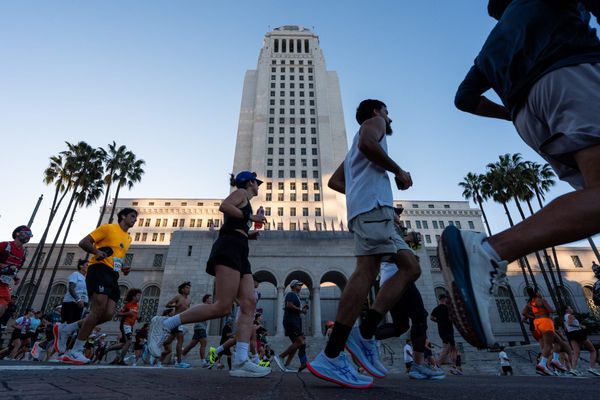
There are people who go for runs, and then there are runners. Going for a run requires a pair of running shoes. Being a runner is a lifestyle, complete with social run clubs, non-alcoholic beer, influencers, gadgets, and even its own social media platform. This summer’s European heat wave has not stopped the runners from venturing out, either in the early morning hours or after dark, and the Strava feeds are full of sunsets and excess sweat. In fact, there are more of these runners today than ever before. The London Marathon released its stats for 2026, and boasted its highest number of entries ever, as well as a significant increase in the number of women trying to get a spot on the start line.
Women’s embrace of running might be seen as a feminist advance, a step beyond patriarchal standards of beauty that saw women as mere ornaments, rather than active beings. Online influencers promote running as a form of self-care that gets you off your phone and into the real world, something that is good for you—and not simply for your dating prospects. With an air of approachability, they invite you to follow along with the progress of their first half or full marathon, or maybe even a full Iron Man. The more extreme the pursuit, and the more “normal” the influencer, the higher the engagement. The treadmill is out, performance goals are in.
But the running itself is not exactly analog. Many of the charming influencers who are taking up the sport are being sponsored by digital apps such as Runna, which provides tailored training plans and comes with a bustling online community. The app tracks the workout via the Garmin running watch. Clearly the sponsorships are working—the women who used to track calories are joining the ever-growing happy crowds at the world’s biggest marathons.
Even I have been bitten by the bug. Inspired in part by my friend who is training for an Iron Man—and because I miss the days where I was easily able to consume a whole pizza—I have signed myself up for a half marathon. The tailored training plans, subscriptions, and electrolytes are lined up to welcome me into the fold.
Suddenly, even recreational exercisers are acting like athletes. The affliction was on full display recently when Steven Bartlett detailed to his audience of young and ambitious billionaire hopefuls the perils that had ensued when he consumed three glasses of wine one evening, and was promptly told off by his Whoop armband. The running watches are also not just made for running. They tell you how you’ve slept, whether you should be taking a rest day, whether you’re drinking enough water, and even adapt your training to your menstrual cycle. Suddenly you’ll start to feel like a workout you haven’t tracked doesn’t count.
“Even professional athletes didn’t use to be this neurotic.”
Even professional athletes didn’t use to be this neurotic. Suzanne Lenglen had cognac in the middle of her 1919 Wimbledon final to soothe her nerves. My old figure skating coach used to reminisce about the wild parties that were thrown on the Friday night before a competition. Perhaps he was exaggerating when he claimed that skaters used to down a glass of vodka for the nerves before a program—the tipsiness wouldn’t set in before the end of the three-minute routine. Instead, our generation of figure skaters was drowned in sports psychology and SMART goals. Now, professional athletes get their bloodwork done, test their VO2 max on fancy machines, and tailor their schedules to eliminate all inefficiencies. The amateurs go as far as they can with wearables and AI-driven personal training plans.
Gen Z might be getting into running, but we are still bored, lonely, and anxious. Perhaps it is no accident that we neurotics are drawn to running, a uniquely trackable sport, where every minor improvement incrementally increases your predicted race times on Strava. Every element of your diet, sleep schedule, and social life can be adapted to it. “Healthy is beautiful” is repeated ad nauseam and we become walking public health campaigns. We are slowly outsourcing intuition to optimizable metrics. Every unforeseen life event or ingested substance can throw off the regimen; complete lack of resilience to any outside stimulus is reframed as health. “Holistic” just means adapting everything to fit your workout routine.
Decades ago, feminists imagined a utopia where women have no scruples about our looks. But the aesthetic approach at least had a vision of a life to look good for. Instead of exercising in order to be able to eat, drink, and enjoy life, “health” has become the whole lifestyle. Too many glances at the ever-present online finger-wagger is a reminder that every cigarette or glass of wine is creating a bodily inefficiency that ought to be eliminated.
There is of course some deception in many people’s super-optimized new fitness regimens—a little hope that the new performance goals will also bring about the perfect body. But it is no more noble to be a metrics obsessive than to want to look good in a bikini. The runners in my life have told me it gets easier over time, that the heaving and panting is only temporary. Hopefully, I won’t need a watch to tell me that I’ve crossed the finish line. And I’ll get through my race with the knowledge that there’s a well-deserved pint and pizza at the end.