


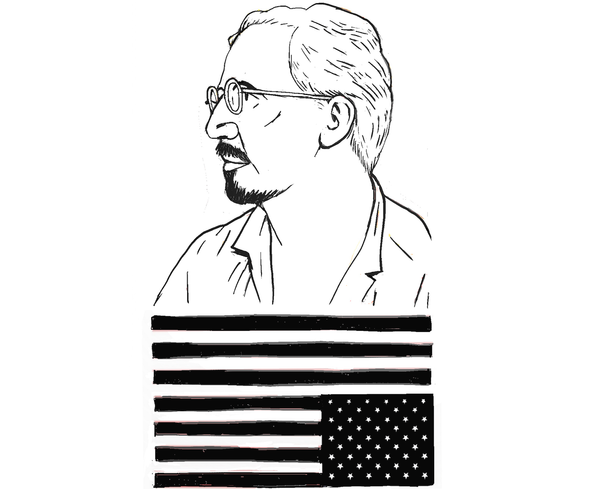
Atrocities of the Mind: Essays on Violence and Politics in the American Century
By Dwight Macdonald
Edited by John Summers
Chicago, 352 pages, $25
When was America great? Despite all that divides Americans today, I suspect a large cross-partisan majority of us, if pressed, would locate the nation’s modern apogee somewhere in the years between 1940 and 1970. The period began with our victory in the “Good War.” What followed was a thirty-ish year stretch of widely shared prosperity marked by high levels of trust and civic engagement, which now furnishes abundant material for nostalgists of all stripes. Conservatives can look back fondly on the era’s stable nuclear families, high fertility levels, and family wage; progressives can cite the combination of high marginal tax rates and booming economic growth, while finding further inspiration in its high union density. Even those who would lament the period’s race and gender stratification still find the template for their activist enterprises in its vibrant social movements.
Perhaps the most revealing cultural document of collective pining for this golden age is the prestige television megahit Mad Men. In 1964, the philosopher Herbert Marcuse, a critic of midcentury American society, denounced “the systematic moronization of children and adults alike by publicity and propaganda.” In the subsequent years, the New Left would take up this line of criticism; a dim view of consumerism and advertising would eventually become widespread. But in the early years of the new millennium, Mad Men managed to get its viewers deeply invested in the success of Don Draper’s and Peggy Olson’s schemes for marketing Lucky Strike cigarettes and Heinz ketchup. Perhaps the appeal was that they were creating and disseminating the icons of something we now seem to have lost: a common American culture. Even a superficial and degraded culture now seems preferable to the current fractured landscape. Any number of “this is what they took from you” memes convey a similar longing.
The work of the essayist and editor Dwight Macdonald serves today as a bracing antidote for this sort of wistfulness about the peak era of the American century. At the outset of the period in question, his was a rare voice on the left that remained firmly opposed to US involvement in World War II. He missed no opportunity to denounce the horrors perpetrated by the war’s victors as well as its losers. Hiroshima, Nagasaki, and the aerial bombing campaigns that laid waste to much of Japan and Germany, as he saw it, were morally of a piece with the atrocities committed by the latter. Later, he slightly moderated his pacifism, declaring that he “chose the West” over the Soviet bloc in the Cold War, even if he did so far less enthusiastically than most of his comrades on the anti-Stalinist left. By the 1960s, though, Macdonald was a vociferous opponent of US involvement in Vietnam who celebrated the rising New Left for its antiwar stance and sought to ally himself with it.
The Macdonald essays collected in the new anthology Atrocities of the Mind focus heavily on America’s wars and showcase the consistency of his oppositional posture throughout the period of American ascendancy. Macdonald departed from Partisan Review, the flagship magazine of the anti-Stalinist left and incubator of the New York Intellectuals, after Pearl Harbor, over his fellow editors’ feeling that now “it was their war and their country,” which he didn’t share. He launched his own magazine, Politics, as a venue for what remained of left-wing opposition to the war. Macdonald’s venture helped launch a number of careers, including that of the radical sociologist C. Wright Mills and the social critic Paul Goodman, and introduced the writing of Simone Weil to US readers; George Orwell was an admirer and contributor.
Politics only lasted five years, and its circulation never rose higher than 5,000, but it made an outsized impact. In a later essay, “Politics Past,” Macdonald explains that he shut it down partly for economic reasons: during the first several years of its existence, the cost of printing doubled. But the closure also marked a retreat from politics at a moment when Macdonald felt increasingly ideologically homeless. The author of an eviscerating takedown of the pro-Soviet 1948 presidential candidate Henry Wallace, he had no truck with the Stalinist left, but he also retained his reservations about the Cold War into which many of his fellow New York Intellectuals had enlisted—in some cases, receiving CIA funding for their trouble.
“Macdonald felt increasingly ideologically homeless.”
What set Macdonald apart from his later New Left antiwar allies—and their successors today—was that his views didn’t proceed from any abstract ideological commitment to “anti-imperialism,” much less to sympathy for the political causes of America’s enemies. Instead, his concern was with “the horror of vast technological power exerted in war-making.” The technological transformation of warfare had brought about a state of “perfect automatism” characterized by an “absolute lack of human consciousness or aims,” culminating in the construction of the nuclear doomsday machine. Rational technoscientific methods had given rise to an entirely irrational, mechanized system that seemed increasingly bent on human destruction.
The apocalypse he saw arriving was, as he put it, “Götterdämmerung without the gods.”
In this regard, Macdonald’s inclinations aligned him with the American small-r republican tradition, which always saw a corrupting effect in prolonged foreign entanglements and the expansion of the military apparatus. It is no accident that the foreword to the new Macdonald collection is written by Andew Bacevich, a conservative anti-interventionist, and that appreciative posthumous profiles of Macdonald have appeared in both of the major paleoconservative publications, Chronicles and The American Conservative. This is a striking contrast with a number of his fellow New York Intellectuals, who found common ground with the right over their hawkish foreign policy views and eventually defected to it on that basis.
Macdonald is probably more widely remembered for his cultural criticism than his foreign policy stances. John Summers, the former Baffler editor responsible for compiling and introducing Atrocities of the Mind, previously edited an anthology of Macdonald’s critical writings, most of them published when he was a staff writer at The New Yorker after shutting down Politics. The title essay in that collection, “Masscult and Midcult,” offered a withering diagnosis of what Macdonald’s contemporaries Theodor Adorno and Max Horkheimer called “the culture industry.”
The emergence of mass culture—“Masscult” was for Macdonald the cultural form taken by the same dehumanizing tendencies he denounced in other areas of advanced industrial society. “A large quantity of people,” he wrote, is “unable to express their human qualities because they are related to each other neither as individuals nor as members of a community.” Mass culture, by this account, is dehumanized culture, created not by artists but by technicians. Attempting to preempt accusations of snobbery, Macdonald wrote that “it is precisely because I do believe in the potentialities of ordinary people that I criticize Masscult.” Even more dangerous, he argued, was “Midcult” or middlebrow culture, which “has the essential qualities of Masscult—the formula, the built-in reaction, the lack of any standard except popularity—but decently covers them with a cultural fig leaf.” It is fortunate he didn’t live long enough to see the rise of prestige TV shows like Mad Men, that Midcult tribute to Masscult.
A brief 1946 essay included in Atrocities reveals the deeper impulse behind all of Macdonald’s geopolitical and cultural provocations. “The trouble,” he wrote there, “is that everything is too big.” It was this bigness—the sheer gargantuan scale and labyrinthine complexity of midcentury American greatness—that he viewed as fundamentally dehumanizing, reducing war, culture, and much else to soulless automatism. Here, he drew on a venerable political tradition in American thought, stretching back to Thomas Jefferson.
I often find myself hostile to this sort of anti-bigness stance. It seems to me that beginning with the cultural triumph of the New Left and stretching through the Reagan revolution and the dotcom boom, a debased neo-Jeffersonian coalition did immense damage to America. Appeals to decentralization, localism, and individual freedom provided cover for the consolidation of wealth and power in the hands of the few, while hollowing out state capacity and laying waste to national industry. Anti-bigness won, and left us with a big mess.
“Anti-bigness won, and left us with a big mess.”
But despite these misgivings, I also found in Macdonald’s political essays that much of what he criticized can be found around us today, and still merits criticism along the same lines. For one thing, massively destructive war has begun to spread across the planet again, most of it just as mindless as and far more mechanized and automated than in the last century; as it was then, so today it is difficult to find writers who will take a moral stance on that troubling reality without quickly betraying that their real investment is in which side prevails, by whatever means. In the ’40s, Macdonald’s former Partisan Review colleagues denounced Politics for pursuing “moral uplift” over “political realism.” But the most intensely moralizing observers of present-day conflicts are, at bottom, also realists for whom moralistic appeals are a way to pursue a politics of competitive victimhood.
In a 1948 essay on the death of Gandhi, Macdonald compared the latter to Leon Trotsky, who had also died by an assassin’s hand eight years earlier. Both these figures were former lodestars for Macdonald, who by the late 1940s had long since abandoned his youthful Trotskyism and was also moving away from his pacifist creed. The essay attempts to find an enduring lesson in how they reacted to the failure of their movements and ideas. Both, he said, had seen themselves “rebuffed by History,” but this was less important than the fact even in defeat, they still tried to give “some kind of meaning, of consciousness to modern political life.”
Gandhi, Macdonald said, “was the last political leader in the world who was a person, not a mask or a radio voice or an institution.” He was also hinting here at how he saw his own literary vocation. In another essay, he remarks of Politics that “a ‘little magazine’ is often more intensively read (and circulated) than the big commercial magazine, being a more individual expression and so appealing with special force to individuals of like minds.” Although he went on to write for publications with far larger circulations, including The New Yorker, he concluded he was better known for his work in Politics because his human presence was better felt by more of his readers. Here, then, is some final inspiration from Macdonald, appropriate for these pages: Perhaps little magazines can still serve as a refuge for human individuals in a new age of cultural and political automatism.