


Korean Messiah: Kim Il Sung and the Christian Roots of North Korea’s Personality Cult
By Jonathan Cheng
Knopf, 768 pages, $36
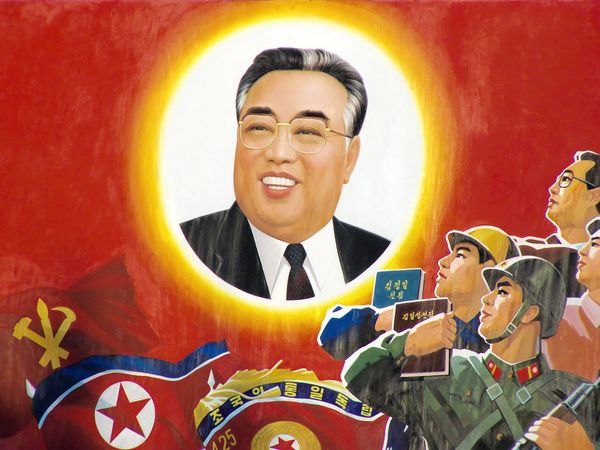
In 1946, a young Korean nationalist named Kim Il Sung stepped onto the stage at the First Congress of the Korean Workers’ Party, held in the immediate aftermath of liberation from Japanese colonial rule. It was likely the first time many Koreans caught sight of the former guerrilla fighter, who would go on to lead the Democratic People’s Republic of Korea for nearly half a century. But even at this early moment, the outlines of his personality cult were coming into view. Over the years that led up to the DPRK’s 1948 founding, Kim’s portraits were plastered across the new nation; posters and pamphlets lauded his revolutionary exploits and presented him as an anticolonial hero and national savior.
But Kim wasn’t the only leader featured in this barrage of propaganda; just as prominent was the figure of Joseph Stalin, an indication of Moscow’s crucial role in building up the North Korean leader’s image. Kim’s successors in Pyongyang have preserved and built on the ideological superstructure he put in place with Soviet help. This makes present-day North Korea the only country in the world that still conserves the regime form created in Stalinist Russia and later exported to aligned countries.
However, recent scholarship has often downplayed the role of Marxist-Leninist ideology and state structures in North Korea, pointing instead to other influences. The latest and perhaps most ambitious effort of this sort is Jonathan Cheng’s Korean Messiah: Kim Il Sung and the Christian Roots of North Korea’s Personality Cult. To account for the rise of Pyongyang’s distinctive ideology, Cheng looks not to communism but to another ideological import that put down roots in Korea: Christianity.
Focusing on the pre-1945 era, Cheng writes a trailblazing narrative of how Christianity made its way to the shores of Korea, where it was eventually adapted into a medium for Korean nationalists opposing Japanese colonialism. He pays particular attention to American Presbyterian missionaries, such as Samuel Moffett, who came to the shores of Korea in 1889 and helped pave the way for US foreign policy in the region.
Cheng is no doubt right that, if one brackets the Kim family regime’s inheritance from Marxism-Leninism as well as strands of anarchist thought, it is possible to read North Korea’s ruling ideology as a kind of secularized red-tinged theology. The Supreme Leader is portrayed in state-run media as a god-like figure, while ordinary citizens are expected to hang on his every word and directive. Saturated with mandatory rituals, moral absolutism, and a messianic personality cult, North Korean ideology bears a resemblance to some forms of Christian fundamentalism.
“This interpretive move risks mistaking form for substance.”
But this interpretive move risks mistaking form for substance. The symbolic parallels to Christianity are mostly superficial, layered onto a political system whose governing logic was forged under Soviet tutelage. In 1949, Anna Louise Strong, a sympathetic leftist who was the first US journalist to report from North Korea, wrote that although “the Koreans seemed to think that they were running things,” the reality was that “the Russians still handled their foreign contacts and supplied their defense—for North Korea had, in autumn of 1947, no army of its own.” Given the overwhelming influence exerted by Moscow during the DPRK’s founding era, to foreground Christian influence risks obscuring the genealogy of the nation’s official ideology. What might appear quasi-Christian in the cult of Kim is better understood as the outgrowth of an imported Stalinism that adopted local customs and rituals to cement its legitimacy.
Pyongyang followed a historical trajectory unlike that of any other communist state. After Nikita Khrushchev’s 1956 “Secret Speech” condemning the excesses of Stalin’s personality cult, de-Stalinization swept across Eastern Europe and much of the socialist world. North Korea, however, never repudiated Stalin, who had been a Georgian seminarian before he became a revolutionary. North Korea’s peculiar political culture, with its cultish leader worship, is best understood as the product of being the only “anti-revisionist” communist state to preserve and reinforce a Stalinist system long after the rest of the socialist bloc had denounced Stalinism. Even Enver Hoxha’s heterodox Stalinist regime in Albania ultimately evolved in a more Sinocentric direction.
Cheng goes to considerable lengths to depict the Kim cult as a Christian heresy. He emphasizes late nineteenth-century Pyongyang’s reputation as the “Jerusalem of the East” and its large number of fervent Christian converts, Kim Il Sung’s parents and grandparents among them. He also highlights the eventual dictator’s devout childhood, during which he attended a Christian church, played the church organ, and taught Sunday school. Kim’s youth, Cheng demonstrates, was steeped in religious zeal.
Korean Messiah is at its strongest when describing pre-1945 Korea; after that, the evidence and arguments get weaker. For instance, Cheng highlights the ritualized practices of slavish devotion to the “Dear Leader” and the mandatory study sessions of Kim’s teachings. In the 1960s, self-criticism sessions became a central part of North Korea’s social fabric—in Cheng’s interpretation, an adaptation of Christian confession. However, he neglects to inform the reader that Stalin first developed the communist concept of “self-criticism” in his 1924 work, The Foundations of Leninism. Self-criticism reached its zenith in Maoist China, when “struggle” sessions became a mandatory public spectacle during the Cultural Revolution.
While it is hard to verify how much Kim Il Sung studied the communist canon, he came of age at the height of Bolshevik rule and spoke in the standard Marxist-Leninist idiom, adopting Lenin’s basic model of of a revolutionary vanguard party establishing the dictatorship of the proletariat. In his 1946 speech during the First Party Congress, Kim stated: “The Workers' Party is an organized combat unit and a vanguard detachment of the working masses. We should at all times firmly defend the unity, purity and strict discipline of the Party.” Needless to say, that is not the typical language of a choir boy. In 1949, the Chargé of the American Mission in Korea wrote in a telegram back to Washington: “Kim II Sung, Stalin’s prototype in North Korea, has been carefully nurtured by Soviets, has been sedulously built up a Korean ‘hero,’ and is in our opinion completely subservient and loyal to Soviet Union.”
Cheng is not the first to challenge the traditional Cold War-era view of North Korea. Bruce Cumings, a historian of Korea retired from the University of Chicago, argued in his 2004 book North Korea: Another Country that Pyongyang’s ideology bore more resemblance to the neo-Confucianism of the Choson dynasty than Soviet-style communism. Later, in his 2011 book The Cleanest Race, literary scholar B.R Myers offered a revisionist account of North Korean nationalism, arguing that it bears a closer resemblance to World War II-era Japanese fascism than to Maoism or Stalinism. Finally and most accurately, Australian scholar Adrian Buzo has characterized North Korea as a “guerilla dynasty” governed on a permanent war footing which inherited its militant character from Kim Il Sung’s anti-Japanese guerilla struggle.
But these reinterpretations risk distracting from what is plainly in front of us: North Korea’s party bureaucracy, administrative practices, and repressive security apparatus are unmistakably Soviet in origin. The regime maintains gulags, a Politburo, a “people’s army,” a highly centralized political system, and a state-directed command economy that grudgingly tolerates the persistence of black markets. Recent revisionist interpretations share a tendency to privilege analogy and symbolism over analysis of institutional structures. The reality is that the North Korean government still operates through a governing logic established in its founding years under Soviet guidance. It retains mechanisms of social engineering, state repression, and ideological surveillance that were the hallmarks of twentieth-century communist regimes.
“Revisionist interpretations share a tendency to privilege analogy and symbolism.”
Despite its questionable conclusions, Cheng’s book is heavily researched and highly readable. He perused thousands of multi-lingual archival documents and primary source materials for this book. His account also offers new lenses for viewing North Korean internal behavior. That is no small feat when studying this highly secretive country.
Cheng does not portray Kim Il Sung as a covert Christian zealot, nor does he depict the DPRK as some hidden fortress of Christendom. Such an interpretation would be difficult to sustain given the regime’s long history of persecuting, imprisoning, and killing Christians. Yet in emphasizing the regime’s purported Christian undercurrents, Cheng downplays the profound influence that Marxism-Leninism exerted on the Korean nationalist movement, the liberation of Korea, and Kim Il Sung himself.
By presenting the ideological origins of the DPRK as Christian in inspiration, Cheng risks exoticizing a country already perceived by many Western readers as uniquely eccentric. North Korea does not become more understandable when detached from the broader history of twentieth-century communism—on the contrary. After a 1969 trip to the DPRK, Black Panther Party leader Eldridge Cleaver declared that the “Motherland of Marxism is Germany; Motherland of Leninism is Russia; Motherland of Marxism-Leninism in our era is Korea.” North Korea’s distinctive political culture makes the most sense when situated within the Marxist-Leninist tradition that shaped its dynastic personality cult, social and political institutions, and intelligence services from the very beginning.