


Presidential elections are now decided in just a handful of competitive states—Pennsylvania, Michigan, Wisconsin, Arizona, and Georgia—where the margin of victory is often measured in tens of thousands of votes. In 2024, Donald Trump carried Pennsylvania by just 100,000 votes by picking up support from middle-class suburbanites in places such as Bucks County, where the annual median household income reaches $112,000, and in older industrial regions like Luzerne County, where the median income is about $64,000.
Economically anxious middle-class swing voters are the decisive force in presidential elections. Whether Democrats can retake the White House will depend on whether the party can convince this band of voters in battleground states that it can effectively address their economic concerns. This is why Democratic Senators Cory Booker and Chris Van Hollen have introduced ambitious proposals for middle-class tax cuts. Their plans are an acknowledgment that the progressive economic policies of recent years have failed, and that something new is needed.
For much of the past fifteen years, historically low interest rates and falling unemployment allowed Democrats to argue for increasing government spending without enacting costly tax increases to cover the bill. They assumed that aggressive public investment could serve as the primary engine of growing the economy and increasing opportunity for most Americans.
When Joe Biden arrived in the White House in 2020 amid the pandemic, Democrats enacted trillions in federal spending. They argued that doing so would not only help the immediate beneficiaries of these programs, but improve economic conditions for all. Instead, inflation surged past 5 percent by the middle of 2021 and peaked at nearly 9 percent in June 2022. Household budgets tightened, and voters began associating Democratic governance with rising prices. The political damage has persisted. In a January 2026 Wall Street Journal poll, voters gave Republicans a six-point advantage on the question of which party was better-equipped to handle the economy and inflation.
“Voters began associating Democratic governance with rising prices.”
Polling over the past year has consistently shown that cost-of-living concerns are top of mind for voters. A Reuters/Ipsos survey released in December found that 46 percent of Americans identified the cost of living as the most important factor influencing how they would vote, placing it far ahead of concerns about democratic norms (22 percent) and immigration (15 percent). A January 2026 New York Times survey found that 65 percent of voters believed a middle-class lifestyle was unattainable for most people, a figure that rises to 74 percent among voters under 45.
Combine a damaged reputation on economic policy and an electorate experiencing affordability anxiety, and the Democratic Party is in a difficult position. Having already exhausted the options when it comes to using federal spending to stimulate growth, Democratic leaders, advocacy groups, and think tanks are now increasingly pushing for new policy agendas centered on the other mechanism of the federal government’s financial power: taxation.
Momentum is building across Democratic states to raise taxes on ultra-wealthy earners and corporations. At the most extreme end of these proposals are wealth taxes being advanced in the states of California and Washington by networks of progressive organizations. These plans would require multimillionaires to pay taxes on unrealized gains. The revenue that would be generated appears to be largely intended to fill budget gaps created by the expiration of Covid-era federal funding for expanded health and social service programs—including preserving eligibility expansions for undocumented populations and possibly financing new poverty-alleviation programs.
Other Democratic states, including in Massachusetts and New York, have seen increases in surtaxes on the wealthy designed to close budget gaps and sustain the growing costs of existing social commitments. Revenue from these additional taxes is largely absorbed by the growing baseline expenses of the welfare state rather than directed toward policies that ease middle-class affordability pressures, which would require more targeted efforts such as first-time homeownership assistance and corporate tax-cut strategies to attract higher-paying jobs.
The limits of these new state-level efforts were already evident in the party’s federal tax agenda under Biden. In 2024, he advanced a tax reform framework that would have increased rates on corporations and households earning above roughly $400,000, with the bulk of new revenue directed toward stabilizing long-term commitments such as Medicare and Social Security. The proposal reflected a governing priority centered on preserving existing social provision rather than delivering immediate financial relief to middle-income households. For voters earning too much to qualify for major social benefits but increasingly strained by housing, childcare, and wage pressures, the plan offered little.
Raising taxes on the wealthy may help sustain the fiscal foundations of the modern welfare state, but it does not on its own constitute an economic agenda capable of winning over middle-class voters who have come to increasingly view government primarily as their annual tax burden rather than an everyday benefit in their lives.
With neither higher spending nor higher taxation offering much benefit to middle-class voters, something else is needed. That’s why some center-left leaders have begun advancing proposals that borrow from traditionally Republican policy frameworks. Alongside the emerging “abundance” agenda, a pro-growth deregulatory approach aimed at increasing innovation and investment, leading Democrats have started to back sweeping middle-class tax cuts.
“Democrats have started to back sweeping middle-class tax cuts.”
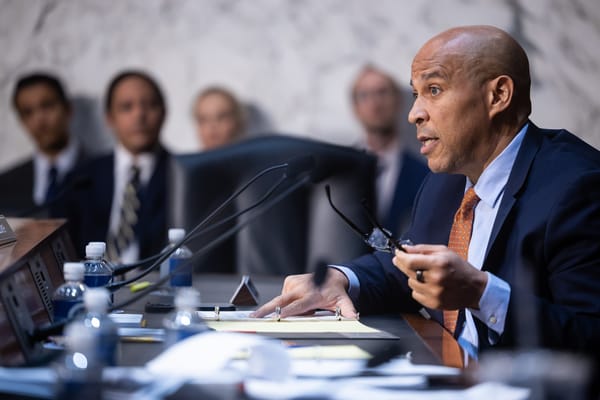
Senators Booker and Van Hollen have taken the lead. In March, each introduced proposals that, in different ways, aim to deliver significant income tax relief to middle class households. Van Hollen’s plan would allow married couples to not pay federal income tax on the first $92,000 they earn through a new “cost-of-living exemption,” which would replace the fixed standard deduction of $30,000, paired with a tax-rate cap. Booker’s proposal would exempt roughly $75,000 of income for married households through a combination of expanded deductions and refundable credits. Though technically different in design, both proposals are intended to dramatically reduce the overall tax liability for a broad segment of the middle class while offsetting lost revenue through surtaxes on high-income earners. To put the impact of these proposals into perspective, the 2017 Republican tax cuts, the last federal tax relief middle-class households received, saved a married couple earning $90,000 roughly $1,500 to $2,000 a year. The Booker and Van Hollen proposals could save that same couple three to four times as much, somewhere between $5,000 and $6,500 annually. Booker and Van Hollen are pursuing a much more expansive vision of middle-class tax relief than Republicans did in 2017.
The emergence of these proposals is a tacit acknowledgement of something Democrats are unable to say out loud: The welfare state the party spent decades building was never really capable of serving the working and middle classes. The programs at core of the Democratic spending agenda—Medicaid, Medicare, Social Security, SNAP, housing vouchers—are either targeted at the very poor or structured as retirement and healthcare safety nets for the elderly. These programs have become essential for millions of Americans, but they do not speak to the working age middle-income voters who earn too much to qualify for major benefits yet not enough to feel financially secure. That gap—between earning too much to receive help, but not enough to feel stable—is where a substantial portion of the battleground electorate lives.
Ultimately, the Booker and Van Hollen proposals are the latest step in the party’s slow retreat from trying to construct a Western European-style welfare state, often characterized by benefits like guaranteed parental paid leave, subsidized childcare, and universal health coverage. With no viable political roadmap or financial plan to achieve this and with existing social programs already consuming the overwhelming share of federal discretionary spending, the senators’ proposals suggest that certain Democrats think the most honest thing the party may be able to offer middle-class households is relief from the obligation of funding those programs in the first place.
This is a remarkable admission. Rather than promising that the federal government can provide more to the middle class, Booker and Van Hollen are suggesting it can at least take less from them.
The Democrats’ turn toward tax cuts comes at a peculiar political moment. American Compass, a center-right think tank with close ties to Vice President JD Vance and Secretary of State Marco Rubio, has been pushing the Republican Party toward its own form of economic heterodoxy, arguing against free-market fundamentalism and calling for tax increases on the wealthy.
“Both movements are responding to the same underlying reality.”
Other parts of the Republican Party are doing the same. Former Republican presidential candidate and Massachusetts governor Mitt Romney wrote an opinion piece in The New York Times arguing for higher taxes on the wealthy. The result is a strange ideological convergence: a center-left wing of the Democratic Party experimenting with tax cuts for the middle class, while a center-right wing of the Republican Party openly calls for more taxes on the wealthy. Both movements are responding to the same underlying reality. Current policies provide a safety net for the very poor and generous advantages for wealthy asset-holders, but have failed to deliver security and stability to a broad swath of middle-class Americans.
Yet new middle-class tax-cut policy ideas do not resolve the Democratic Party’s deeper political dilemma. Democratic power is rooted in large metropolitan areas dominated by the demands of lower-income constituencies, Democratic state-level officials, public sector institutions, and advocacy networks focused on expanding poverty-alleviation programs. Maintaining those commitments absorbs enormous political and fiscal energy. Democrats in Congress face sustained pressure from these stakeholders to use their limited leverage to protect existing programs from Republican cuts or to secure additional funding to keep up with rising costs.
This means that the party’s primary source of its governing power serves as a limiting factor in presidential races, which are decided by moderate, middle class voters who often experience government less as a source of benefits than as a source of obligations. Until Democrats resolve this issue, they will have trouble building a governing majority.