


The verdict is in: The United States has failed in Iran. Intoxicated by their hubris, the Americans and their Israeli allies assumed that they could use unrelenting force to neutralize a longstanding recalcitrant adversary—but that has backfired. The Islamic Republic, though battered and bruised, is still standing, surviving economic warfare, deceptive diplomacy, targeted assassinations, regime decapitation, and mass aerial bombings of military and civilian infrastructure. Tehran’s asymmetrical hybrid warfare has rendered most US bases in the region inoperable and effectively shut the Strait of Hormuz, thus putting the global economy in a vise.
This defeat, the narrative goes on, has confirmed that the American empire is in an irreversible decline. Washington’s global prestige lies in ruins. The Trump administration has launched military operations in Venezuela, Nigeria, and Iran, while bombing boats, threatening Cuba, flirting with raids on Mexican territory, and saber-rattling over Canada and Greenland. But these shows of force are just attempts to mask the decline of US power and disguise the emergence of a multipolar world. The third Gulf War is the “American Suez.”
“A story of a humbled Goliath always has wide appeal.”
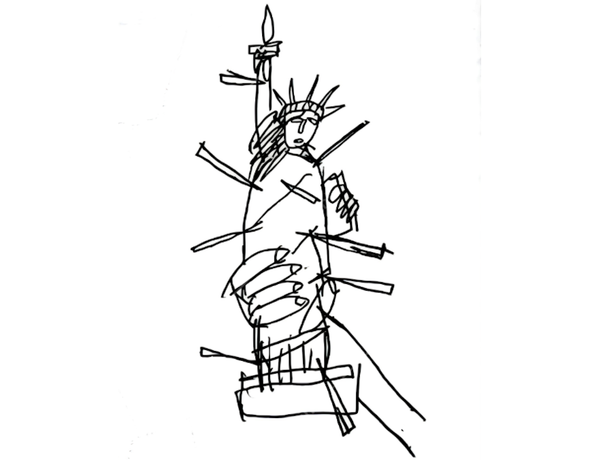
The Iran war has revived a familiar prophecy of American collapse, and a story of a humbled Goliath always has wide appeal. But the real story may be stranger: Pax Americana is not ending—it is adapting, shedding its neoliberal character and putting on a neo-developmental statism, and its endurance is what keeps corrupting the American republic.
Declarations of the American empire’s inevitable end go as far back as the Sputnik launch in the 1950s, when the Soviet system of planning seemed to many people to be more dynamic and at risk of leaving America behind. In the 1970s, a decade in which the US imperium experienced multiple strategic defeats and humiliations to its global image—including the oil crisis, the Nixon shock, persistent stagflation, the fall of Saigon, client states in the Third World falling to Soviet influence, the Iranian revolution—American decline seemed very plausible.
In his bestselling 1987 book The Rise and Fall of Great Powers, the historian Paul Kennedy repeated the prediction that American power was fraying and multipolarity would soon rule the day. Only a few years later, though, the world arrived at what everyone now recognizes as the “unipolar” moment at the end of the Cold War. In the same period, the economist Giovanni Arigghi predicted that Japan would supplant the United States as the capitalist hegemon and the Yen would be the global reserve currency. Then, Japan’s “lost decade” happened—prompting Arigghi to latch onto China as the next rising superpower.
It would be fallacious to conclude that because previous claims of American decline were premature, the current ones also are. On a long enough time scale, such predictions must eventually turn out to be true. Nothing lasts forever. But at that point, we’ve left geopolitical predictions behind for the realm of prophecy.
The truth is that Pax Americana isn’t going anywhere anytime soon. There are a few straightforward material reasons: The dollar is still the reserve currency and the anchor of the global financial system, and no credible alternative has emerged. The US navy is still the guarantor of naval shipping lanes across the world, facilitating global trade; no one else seems up for taking up that responsibility either. In the 1970s, the United States was far more dependent on Middle Eastern oil imports, so could be held hostage by energy shocks. Due to the shale revolution of the 2000s, America is the biggest producer of liquid fuels in the world, thus becoming a net energy exporter and relatively energy independent, to the point that the Iran war has strengthened America’s hand as an energy power, at the cost of the rest of the world.
But there is a deeper reason for America’s enduring preeminence. The basis of American power is neither merely military nor economic. Rather, it is based on its social power, which in turn has its roots in revolution.
Present-day America is the legatee of two earth-shattering world-historical revolutions: that of 1776 and that of 1861 to ’65, encapsulated in the Declaration of Independence, the Gettysburg Address, the Emancipation Proclamation, and the Thirteenth and Fourteenth Amendments. These go far deeper and have had a more powerful effect on world history than the theocratic counter-revolution in Persia in 1979 or the Chinese Communist Party’s seizure of power in 1949. The result of this history is that the United States doesn’t have a single source of power, but many, which creates a polity that can more easily adapt and renew itself—a factor often underestimated by America’s adversaries. It is not a coincidence that it is also the world’s only superpower.
The problem is that this position has also been a tragedy for the American republic. Ever since the United States entered the grand stage of Weltpolitik, beginning with the Spanish-American war in 1898, but really culminating in the aftermath of the two world wars (both forced on America by the European empires), imperialism has necessitated the growth of an overbearing bureaucratic state, or the fourth branch of government, as Woodrow Wilson phrased it, that dominates at home and abroad and must violate the constitution to function.
Liberal critics of American imperialism since the Anti-Imperialist League rightly recognized that imperialism is the barbarization of the promise of America. In an 1899 lecture titled “The Conquest of the United States by Spain,” William Graham Sumner decried the fact that though the United States had defeated Spain on the battlefield, ultimately Spain had the last laugh. This was because the “old-world” pathologies that the American republic was founded as a repudiation of were being adopted that would inevitably lead to “war, debt, taxation, diplomacy, a grand-government system, pomp, glory, a big army and navy, lavish expenditures, and political jobbery,” which would corrupt the nation. Sumner was right then, and is still right now.
Not long after the Berlin Wall fell, one of the leading lights of neoconservatism, Jeane Kirkpatrick, called for America to “give up the dubious benefits of superpower status and become again an unusually successful, open American republic”—to be a “normal country in normal times” and operate as an “independent nation among independent nations.” Some supporters hoped this was what Trump meant by “America First,” but have been left disillusioned by the Iran war, which has repeated the familiar folly of entangling America in distant foreign adventures that direct military and monetary power away from the national interest.
“America isn’t going to be a ‘normal’ country anytime soon.”
But however much Americans may wish to retire from world politics, America isn’t going to be a “normal” country anytime soon. Its preeminence on the world stage in the future is a given, for good and for ill. It will remain the leading capitalist power in the world and the guarantor of world order and global capitalism because it is the only country that can take up the necessary responsibility; none of the supposed challengers have the desire or capacity to do so.
It is telling that declarations of the end of Pax Americana have coincided with major crises in global capitalism: The 1970s, which heralded the shift from Fordism to neoliberalism, and now with the crisis of neoliberalism, which is giving rise to a still inchoate new order. What seems to be coming into view is the emergence of a neo-developmental state that uses industrial policy to pursue technological sovereignty and consolidate strategic alliances and resource control. In this new dispensation, global interdependence is increasingly weaponized as a tool of geopolitical coercion, legitimated by an ideological framework that is more “civilizational” than “globalist.”
But in this order, Pax Americana will endure under transformed conditions. Continuity and change will occur at once. It won’t look the same as it once did, but don’t mistake this for inevitable American imperial decline. America is often described as a global cop, and as with any police force, we resent them and lambaste them when they behave like criminals even when they go after real criminals, but we also can’t do without them. The hard question we must ask ourselves is what it would take to create a world that no longer needs a cop to police it.