


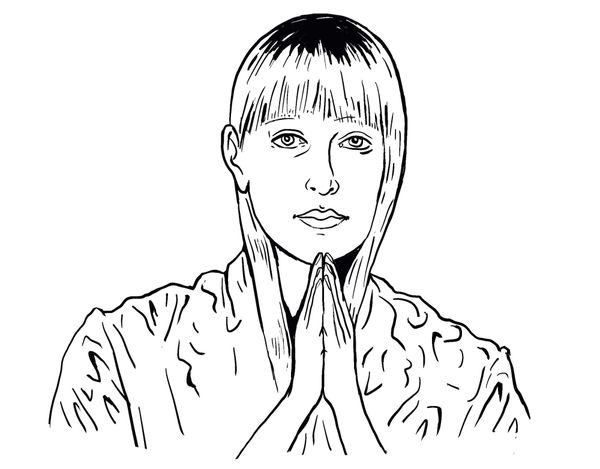
Norway is one of the world’s least religious countries, but the spirit is moving some of its most interesting artists. Jon Fosse, the Nobel-winning novelist, is a Catholic who writes of lonely men’s encounters with divine providence. Karl Ove Knausgaard, a writer known for minute realism, has turned to supernatural themes. And now Susanne Sundfør, an independent musician known for snappy dance numbers and tales of heartbreak, has released Revelations of Divine Love, a record whose lyrics are drawn entirely from the writings of the fourteenth-century mystic Julian of Norwich.
Some religious artworks are the expressions of broadly believing cultures—think Bach’s Mass in B Minor or the cathedral at Chartres. But today, religious art often has a different character. Rather than giving voice to the dominant outlook, religion becomes a site of resistance to mainstream values. In this way, it can prove attractive to people who normally would not be drawn to dogmatic belief.
“Religion becomes a site of resistance to mainstream values.”
“There is a mysticism wave happening among artists in Europe,” Sundfør tells me. Her new album, co-written with the organist Kit Downes, exemplifies this trend. Though Sundfør is not Catholic or avowedly Christian, she has produced a remarkable piece of sacred music, her supple voice lending poignancy to the unexpected affirmation that God is what “Holy Church preacheth and teacheth thee.”
Sundfør came across Julian’s writings at a time when a friend of hers was suffering from breast cancer—and joining the Catholic Church. What she found surprised her. “It felt like something a guru in the ’60s New Age movement would write, but it was Christian. And I hadn’t really been introduced to that kind of Christianity before.”
Part of the attraction was feminist, though not in the conventional sense of that word. In Julian’s writing, and in Catholic piety generally, Sundfør finds compelling images of womanhood. “The religious story that makes the most sense to me is Jesus and Mary,” she says. “I think it’s what a society should be based on, mother and child.”
This vision of womanhood is especially attractive in a society that is at once prurient and censorious. “Sex is very distorted,” Sundfør says. “It’s either Puritan or porn.” She views sex in religious terms as something positive. “To me, sex is sacred. I think that’s a problem we have around sexuality today, that it’s become sort of secularized, for lack of a better word.”
Sundfør’s high view of sex and motherhood explains the album’s cover art. It shows a woman giving birth, her face lit with ecstasy. Based on a photo from the natural birth advocate Ina May Gaskin, it depicts a phenomenon reported by midwives, in which the woman climaxes during delivery.
Unsurprisingly, the cover art has been censored by music platforms such as Apple and Spotify. Sundfør hesitated before using it, but she finally decided that it was necessary to convey her meaning. For her, the image has a specific theological resonance. “In the Scripture, they say that Mary gave birth without pain,” she notes. “There’s a theory within Christianity that Jesus reversed Adam’s sins, Mary reversed Eve’s sins”—a reference to the patristic idea of Mary as the “new Eve.” This reversal entailed the lifting of a curse described in Genesis. “What was the consequence of Eve’s misdoings or errors? She had to have pain in childbirth. And then Mary didn’t.”
In this way, an explicit image drawn from an alternative birth manual comes to express a spiritual longing for the restoration of motherhood—so that it ceases to be painful or despised, and becomes instead an unmixed blessing.
Sundfør’s own experience of childbirth helped her understand the words of Julian. The mystic’s great theme is trust in divine providence—God’s control over all that happens. Thus her famous words, “All shall be well.” As Sundfør notes, midwives often tell mothers to “trust the process” in order to avoid anxiety — a kind of lesson in relying on providence.
That trust can be seen on her album’s cover and in Julian’s writing. “Here is a woman who is in complete trust of the wonder that is about to happen,” Sundfør says. “And only then can you sort of give birth to someone in such ecstasy. So it’s like the ultimate image of love, really.”
Sundfør understands her exploration of faith as a response to a universal longing. “I think we’re supposed to be religious. I don’t think it’s natural for human beings to not be religious,” she says. “It creates a vacuum in us, and we need to fill it with something.”
If Sundfør is right, people in secular societies will continue to search for some source of spiritual meaning. Where will they find it? Ever since she was a child, Sundfør says, she has been “searching for something bigger.” She has found intimations of that something in the words of a medieval mystic and in the relationship between Jesus and Mary. “Love really is bigger,” she tells me.